
AWVB
  • Nederlands
Contact
  • Research
    • Self-determination & experiential expertise
    • Families
    • Quality care & professional support
    • eHealth
    • Complex care
  • For practice and education
    • Websites & web apps
    • Methods & questionnaires
    • Factsheets & infographics
    • Manuals & training courses
    • Videos
    • Educational modules for vocational training
  • About us
    • Organization
    • Mission and vision
    • Approach
    • Partnership
    • Our team
    • Advisory Board
    • Frequently asked questions
Home > For practice and education > Factsheets & infographics > Experience research: Coercion in care

Experience research: Coercion in care

Coercive measures should have no place in the care of people with dementia or intellectual disabilities. Decisions about involuntary care are often made by professionals, but the client’s perspective is crucial. The AWVB’s Coercion in Care research focused on including this perspective in decision-making.

23_Factsheet Dwang in de zorg_zorgverleners_ENG_def_website

The results are summarized in two factsheets—one for care professionals and one for family members—and also form part of the Client Perspective Weighting Framework, an online tool for professionals and behavioral specialists.
Want to know more about this practice product?

Email us at awvb@tilburguniversity.edu

You may also be interested in

Complexe zorg E-health
21 May 2021

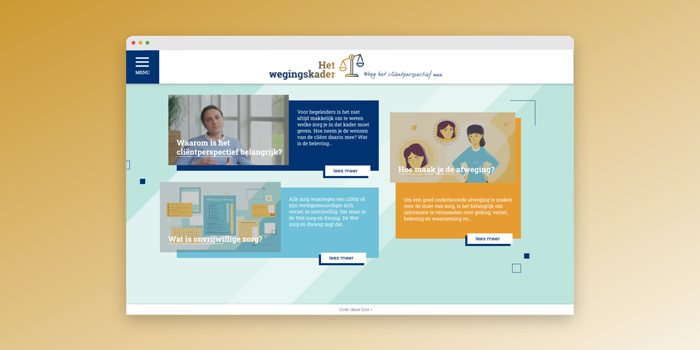
The Assessment Framework

The Assessment Framework (in Dutch only) includes a website with methods, practical videos, and textual information about taking the perspective of the service users. Supported by clear and concise explanations, videos, and easily recognisable icons, the healthcare professional systematically collects information about the individual’s specific healthcare situation.
Read more
Eigen regie & ervaringsdeskundigheid
8 November 2021

Control over one’s own outpatient treatment

Having control over one’s own life and care is important for everyone, including people with mild intellectual disabilities or borderline intellectual functioning and psychiatric problems.
Read more
  • Home
  • Themes
  • For practice and education
  • About us
  • Contact us
Visiting address

Tranzo, AWVB
Professor Cobbenhagenlaan 125
5037 DB Tilburg
Reitse Poort 1, 2nd floor
The Netherlands

Postal Address

Tilburg University
Tranzo, AWVB
Postbus 90153
5000 LE Tilburg
The Netherlands

  • Academic Collaborative Center Living with an intellectual disability (AWVB)

What are you searching for?

Popular searches

  • Beat the kick
  • Factsheets & infographics
  • Self-determination & experiential expertise
Close
  • Research
    • Self-determination & experiential expertise
    • Families
    • Quality care & professional support
    • eHealth
    • Complex care
  • For practice and education
    • Websites & web apps
    • Methods & questionnaires
    • Factsheets & infographics
    • Manuals & training courses
    • Videos
    • Educational modules for vocational training
  • About us
    • Organization
    • Mission and vision
    • Approach
    • Partnership
    • Our team
    • Advisory Board
    • Frequently asked questions
  • Contact
  • Nederlands
Search